
I started to experiment with the WS2812 LED, more specifically the WS2812B, which is a better revision in term of connections. These are the very famous individually addressable RGB LED, where tons of sources are available. Mainly due to their low cost, they are spread to the maker scene like a rhinovirus in a primary … Continue reading Experiments in implementing the WS2812B protocol in AVR MCUs without bit-banging
Author: Enrico S.
AOC I2475PXQU LCD monitor – teardown and repair
One of few repairs that went smooth and succesful. Using a monitor with integrated USB hub can be useful, but also tricky, if such hubs are designed in a cheap way or is not fool proof, and I am a fool. If that is the case, overloading the output lead to a dead port. And … Continue reading AOC I2475PXQU LCD monitor – teardown and repair
Switching converters nostalgia: a brief history
I have some kind of interest in electronic projects, whether hobbists or a professional ones, which are based on standard and always available sub-components. Those always available parts are also called jelly bean components, like resistors, capacitors and cheap basic parts, like op amps (including in my opinion also LM741, LM324, even TL081 and the … Continue reading Switching converters nostalgia: a brief history
Glighter-A driver LED – The mixed signal control
It was not long time ago in which was developed a small DC-DC LED driver - Glighter-S, my first switching LED driver. It was the natural consequence of the need for efficiency after the development experiment of the linear LED driver - Glighter. No long time after these experiments, the need for analog control in … Continue reading Glighter-A driver LED – The mixed signal control
Dimming LEDs (part 3/3) – The overlooked boundaries
In the last PWM discussion, we devised how is composed the average current, specially when the PWM frequency is faster than it should be, making the period duration comparable with the rise and fall slopes duration of the current. The results were packed up in 2 equations to summarize what is the best choice for … Continue reading Dimming LEDs (part 3/3) – The overlooked boundaries
Dimming LEDs (part 2/3) – Sneaky non-linear events while using the PWM technique
In the previous article we tried to analyze what is the Contrast Ratio in a LED driver and how the non-idealities are giving a boundary on the minimum allowable PWM period. That was quite worth a full article, but a big part was indeed missing. Here we will go through how the PWM period and … Continue reading Dimming LEDs (part 2/3) – Sneaky non-linear events while using the PWM technique
Dimming LEDs (part 1/3) – Analog and digital, not analog vs. digital
While messing around with dimmable DC-DC converters for LED drivers, I had the need to quantify the contrast ratio of a dimmable light. Turns out it is not that trivial, specially when combining switching periods, transients and mixed analog/PWM dimming. Looking for contrast ratio on the internet is only useful if you want to buy a TV, not if you want to build a LED driver. Also, on the web not all information seems to be correct, therefore this article and its possible continuation is the result of long investigations and discussions between engineers.
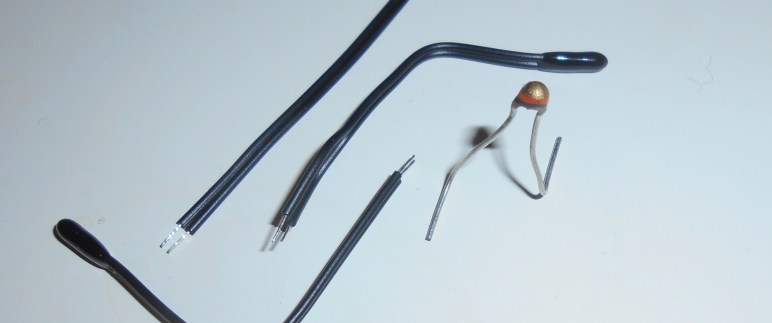
NTC Measurements (part 2/2)
In the previous NTC Measurements article, was shown the basic approaches and few variations of them in order to use an NTC, by following the suggestions provided in the datasheet and taking the correct assumptions in all the temperature signal processing. These suggestions are usually not provided, because with a bit of math a lot … Continue reading NTC Measurements (part 2/2)
DS1307 RTC Emulator – The Arduino library
Things must come to an end. I decided to make a new library experiment, putting an ending mark to the DS1307 Real Time Clock hacking project, because the project was born as an encapsulation of a real RTC in a PIC microcontroller, wrapping an RTC hardware engine to emulate the DS1307; then a subsequent development on … Continue reading DS1307 RTC Emulator – The Arduino library
HardWire, the enhanced Arduino Wire library
I have spent a lot of time on playing and later working on the I2C buses. I almost always used self developed libraries, both for learning and job requirement purposes. Then, when experimenting with a portability of a project in the Arduino environment, I started to trying the official Wire library, discovering some incompatibilities for my … Continue reading HardWire, the enhanced Arduino Wire library
 ALEA
ALEA 